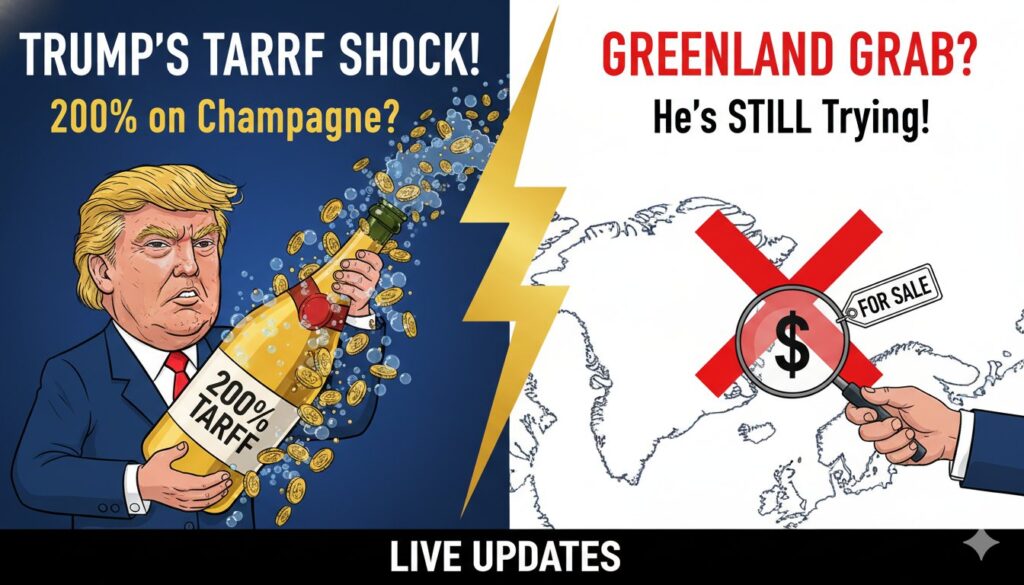

President Trump has escalated trade tensions by threatening a 200% tariff on French wines and champagne in response to perceived snubs from European leaders, while reaffirming U.S. intentions to secure control over Greenland through economic pressure on opposing nations, triggering market volatility and diplomatic fallout.
President Trump’s latest trade maneuvers have sent shockwaves through global markets, with a pointed threat against French luxury exports at the forefront. In a bold escalation, he has signaled readiness to impose a 200% tariff on French wines and champagnes, framing it as leverage to compel European alignment with U.S. foreign policy goals. This comes amid reports of a leaked private exchange with French leadership, where concerns over U.S. territorial ambitions were raised, further straining transatlantic relations.
The tariff threat appears tied to broader diplomatic frustrations, particularly around a proposed international framework aimed at resolving global conflicts. Trump has publicly suggested that non-cooperation from key allies could result in swift economic repercussions, emphasizing that such measures would protect American interests without hesitation. Analysts view this as a continuation of a hardline approach to trade, where tariffs serve as both punishment and incentive, potentially disrupting supply chains for high-end beverages that generate billions in annual U.S. imports.
Simultaneously, Trump has intensified rhetoric on Greenland, insisting that U.S. oversight of the territory is essential for strategic security, citing untapped resources like rare earth minerals, lithium, and uranium as critical to countering influence from rival powers. He has reiterated that acquisition could proceed through negotiation or more assertive means, dismissing opposition as shortsighted. This stance has already led to announced 10% tariffs on exports from eight European nations deemed obstructive, effective next month unless positions shift.
Market reactions have been immediate and pronounced. European equities have tumbled, with major indices dropping amid fears of a renewed trade war. The Stoxx 600 fell sharply in early trading, underperforming global peers as investors braced for retaliatory measures. Luxury goods sectors, particularly those tied to French producers, saw steep declines, with shares in conglomerates holding wine and spirits portfolios shedding value rapidly.
| Market Impact Overview | Change (%) | Key Drivers |
|---|---|---|
| Stoxx 600 Index | -1.8 | Tariff fears on EU exports |
| French CAC 40 | -2.3 | Direct hit to luxury beverage sector |
| Gold Prices | +1.5 | Safe-haven buying amid uncertainty |
| Bitcoin | -2.5 | Risk-off sentiment in volatile assets |
| U.S. Treasury Yields | -0.12 | Flight to bonds as equities slide |
Cryptocurrency markets also felt the ripple effects, with Bitcoin dipping below key support levels as broader risk aversion took hold. Traders attribute this to the interconnected nature of global finance, where U.S. policy shifts can amplify volatility in digital assets. Meanwhile, gold has surged to new highs, reflecting investor preference for tangible hedges against geopolitical instability.
Key Points from the Developments:
Tariff Mechanics and Targets : The proposed 200% levy on champagne and wines would effectively double or triple retail prices in the U.S., impacting importers, distributors, and consumers. This mirrors past trade actions but escalates the scale, potentially adding hundreds of millions in costs to the industry annually.
Greenland Strategic Value : Beyond resources, Greenland’s position offers control over Arctic shipping routes and military basing, seen as vital for U.S. dominance in emerging polar competitions. Trump has framed this as a non-negotiable priority, arguing it prevents adversarial encroachments.
Diplomatic Ramifications : Leaked communications highlight growing rifts, with European officials rallying in support of territorial sovereignty. Protests have erupted in affected regions, underscoring public backlash against perceived overreach.
Economic Projections : If implemented, these tariffs could shave 0.2-0.5% off EU GDP growth, per preliminary estimates, while boosting U.S. domestic producers marginally. However, retaliation risks escalating into a full-blown trade conflict, affecting everything from automobiles to agricultural goods.
Sector-Specific Fallout : The beverage industry faces immediate supply disruptions, with champagne houses already exploring alternative markets. Broader luxury sectors, including fashion and cosmetics, are monitoring for spillover effects.
In the credit markets, primary issuance has stalled, with only a handful of deals pricing amid the uncertainty. European high-yield bonds have widened spreads, signaling heightened default risks for export-dependent firms. Investment banks are advising clients to hedge against currency fluctuations, particularly the euro’s depreciation against the dollar.
Broader Trade Strategy Insights: Trump’s approach blends economic nationalism with geopolitical maneuvering, using tariffs as a multifaceted tool. This has precedents in prior administrations but amplifies them through unpredictability. Financial institutions are recalibrating models to account for “tariff shocks,” with some forecasting a 15-20% rise in import costs for targeted goods if tensions persist.
Live Market Updates Section: As of the latest trading sessions, U.S. futures remain mixed, with Dow Jones contracts edging higher on domestic strength, while Nasdaq leans negative due to tech exposure to international supply chains. European bourses continue to lag, with safe-haven flows into Swiss and German assets. Currency traders are watching the USD/EUR pair closely, which has strengthened amid the dollar’s appeal in uncertain times.
Potential Scenarios Ahead:
Escalation Path : If European concessions falter, additional tariffs could extend to other sectors, prompting WTO challenges and alliance strains.
De-escalation Opportunities : Diplomatic backchannels at international forums might yield compromises, such as joint resource development pacts.
Investor Strategies : Diversification into non-tariff-impacted assets, like emerging markets or commodities, is gaining traction among portfolio managers.
This unfolding situation underscores the intersection of trade policy and national security, with far-reaching implications for global finance. Stakeholders from importers to exporters are urged to monitor developments closely, as shifts could redefine transatlantic economic dynamics for years to come.
Disclaimer: This news report is for informational purposes only and does not constitute financial advice or investment recommendations. All tips and insights are based on general market observations.