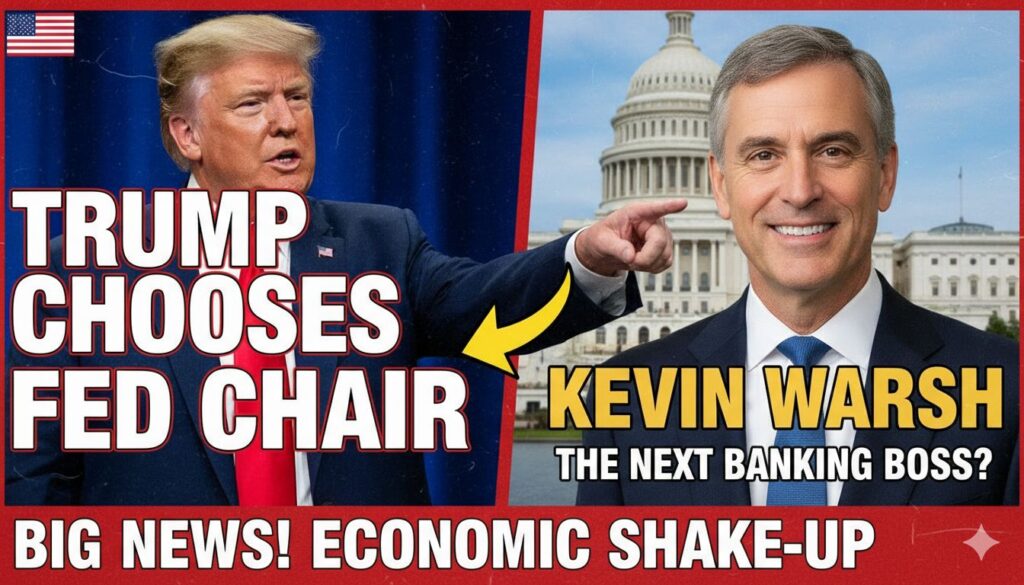

President Donald Trump has nominated former Federal Reserve Governor Kevin Warsh to succeed Jerome Powell as chair of the Federal Reserve, a move that ends months of speculation and signals the administration’s intent to reshape monetary policy direction. Warsh, a seasoned policymaker with deep Wall Street ties, faces Senate confirmation amid ongoing debates over Fed independence and interest rate strategy.
Trump’s Selection of Warsh President Donald Trump announced on Truth Social that he is nominating Kevin Warsh to serve as the next chair of the Federal Reserve, with the change set to take effect following Jerome Powell’s term expiration in May. Trump described Warsh as someone he has known for a long time, expressing full confidence that Warsh would rank among the greatest Fed chairs in history. He emphasized Warsh’s commanding presence and reliability, calling him “central casting” and someone who would never disappoint.
The announcement concludes an extended search process that involved interviews with several high-profile candidates. Trump highlighted the caliber of the finalists, noting that all possessed outstanding qualifications and promising futures in public service. The selection reflects the administration’s priority to install leadership perceived as more aligned with aggressive rate-cutting measures and accountability at the central bank.
Kevin Warsh’s Professional Background Kevin Warsh, 55, brings significant experience to the role. He served as a member of the Federal Reserve Board of Governors from 2006 to 2011, nominated by President George W. Bush. During his tenure, he represented the Fed at international forums including the G20 and focused on financial markets and economic developments. Prior to the Fed, Warsh worked as special assistant to the president for economic policy in the Bush White House from 2002 to 2006.
Outside government, Warsh has held senior positions in the private sector, including roles at major financial institutions and corporate boards. He currently serves as a lecturer at Stanford Graduate School of Business and maintains affiliations with organizations such as the Hoover Institution. His background combines legal training, investment banking expertise, and high-level policy experience, though he is not formally trained as an economist.
Warsh’s Perspectives on Monetary Policy Warsh has long been a vocal commentator on central banking. He has criticized aspects of the Fed’s post-financial crisis approach, particularly the expansion of its balance sheet through quantitative easing and what he views as overreach into areas beyond core mandates. He has argued that the institution has at times lost focus on price stability, contributing to credibility challenges.
More recently, Warsh has advocated for adjustments in policy direction. He has expressed support for lower policy rates in the current environment, potentially balanced by efforts to reduce the Fed’s footprint in financial markets. His comments suggest a belief that the central bank should prioritize inflation control while adapting to economic realities such as labor market dynamics and technological influences like AI that could exert downward pressure on prices.
This stance aligns with the administration’s repeated calls for faster reductions in borrowing costs to support growth. At the same time, Warsh has defended the importance of Fed independence, even while critiquing specific decisions and leadership approaches.
Context of the Nomination The choice comes against a backdrop of heightened tension between the White House and the Federal Reserve. President Trump has consistently pressed for lower interest rates, viewing them as essential for economic expansion. The current fed funds rate sits in the 3.5% to 3.75% range, considered neutral relative to inflation and employment objectives. Market expectations point to limited additional easing in the near term.
Powell, who has led the Fed since 2018, has navigated multiple economic crises and maintained a focus on the dual mandate of maximum employment and stable prices. His remaining time as a governor extends beyond the chairmanship, potentially influencing board dynamics during any transition.
Market and Economic Implications Initial market reactions to the nomination were mixed. The U.S. dollar strengthened modestly in early trading before pulling back, while gold prices declined significantly to around $5,132 per ounce. Wall Street opened lower but showed some recovery as participants assessed Warsh as a credible figure likely to maintain institutional stability while delivering near-term rate relief.
Analysts note that Warsh’s nomination may ease concerns about more disruptive alternatives, positioning him as a bridge between market respect and administration priorities. Longer-term, his emphasis on a smaller balance sheet could influence bond yields and financial conditions. The broader economy faces ongoing challenges, including inflation above target levels, moderating labor demand, and cautious consumer spending.
Senate Confirmation Challenges Warsh’s path to confirmation requires Senate approval, with Republicans holding a 53-47 majority. Support has emerged from key figures, including the chair of the Senate banking committee, who praised Warsh’s market knowledge and alignment with accountability goals.
However, opposition exists within the Republican caucus. Some senators have indicated they will block Fed nominees until related investigations conclude, citing concerns over procedural fairness and institutional independence. Democratic members have also raised questions about preserving the Fed’s autonomy.
Key Candidates Considered
Kevin Warsh — Nominated; former Fed governor with policy and market experience.
Christopher Waller — Current Fed governor; strong internal candidate.
Rick Rieder — BlackRock fixed income executive; congratulated Warsh on the selection.
Kevin Hassett — National Economic Council director; praised by Trump but retained in current role.
The nomination marks a pivotal moment for U.S. monetary policy, with Warsh positioned to lead the central bank through a period of economic transition and political scrutiny.
Disclaimer: This is a news report based on current events and public statements. It does not constitute financial, investment, or policy advice. Readers should consult qualified professionals for personal decisions.