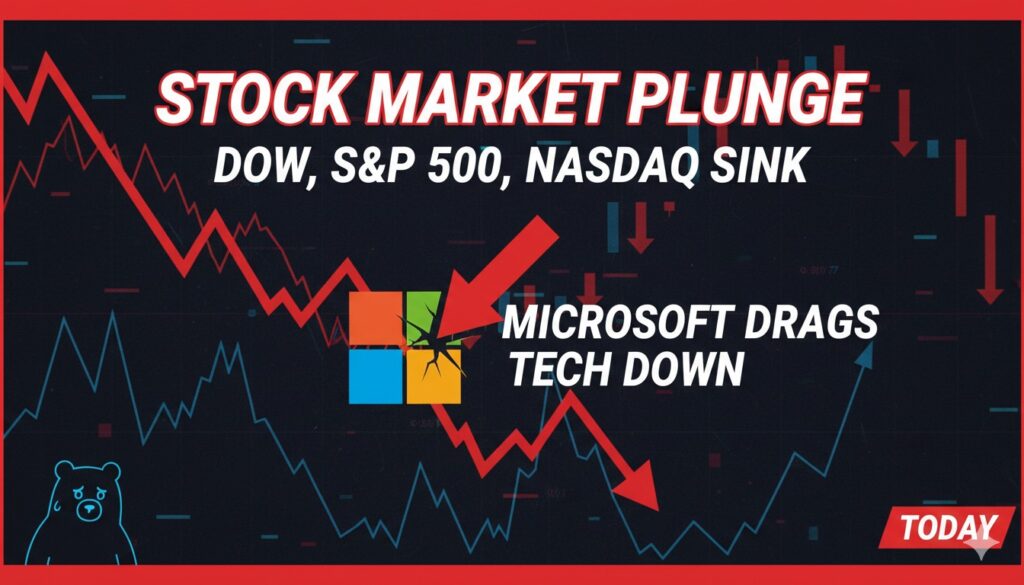

“U.S. stock indices experienced significant declines on Thursday, with the Nasdaq leading the downturn at nearly 2%, dragged by a 12% plunge in Microsoft shares following concerns over slowing cloud growth and escalating AI investments despite beating earnings estimates. The S&P 500 fell about 1%, while the Dow dipped marginally by 0.2%, as gains in some sectors like airlines and industrials offset tech losses. Other tech giants showed mixed results, with Meta surging 9% on strong outlook and Tesla slipping 3% amid strategic shifts, while commodities like gold pulled back after hitting records.”
Wall Street faced a turbulent session as major indices retreated, primarily weighed down by weakness in the technology sector. The Nasdaq Composite slid 1.87% to 23,411.62, marking its sharpest drop since October and reflecting broad pressure on software and cloud-related stocks. The benchmark S&P 500 declined 1.02% to 6,906.80, erasing early flirtations with the 7,000 milestone achieved briefly in prior trading. Meanwhile, the Dow Jones Industrial Average managed a more modest loss of 0.20% to 48,915.70, buoyed by resilience in non-tech components.
The selloff intensified in the tech-heavy arenas, where Microsoft’s post-earnings reaction served as the catalyst. Shares of the software behemoth cratered 12.05% to 423.60, shedding over 58 points and exerting outsized influence on both the Nasdaq and S&P 500 due to its hefty weighting. Investors fixated on decelerating growth in the Azure cloud division, which expanded 39%—a notch below the prior quarter’s 40% pace—and ballooning capital expenditures tied to artificial intelligence initiatives, which hit record levels and exceeded analyst projections. This overshadowed the company’s fiscal second-quarter results, which included revenue of 81.27 billion dollars and earnings per share of 5.16, both surpassing consensus forecasts.
Broader software stocks echoed Microsoft’s woes, amplifying the sector’s downturn. The S&P 500 Information Technology Sector plummeted 3.5%, emerging as the day’s worst performer among the 11 major sectors. Notable decliners included Atlassian, down 12%, ServiceNow off 11%, Intuit dropping 8%, and Salesforce shedding 7%. These moves were exacerbated by similar concerns from European peer SAP, which tumbled 16% after its earnings revived fears of AI-driven disruptions in enterprise software.
Key Earnings Spotlights and Stock Reactions
| Index | Closing Value | Point Change | Percentage Change |
|---|---|---|---|
| Dow Jones Industrial Average | 48,915.70 | -99.90 | -0.20% |
| S&P 500 | 6,906.80 | -71.23 | -1.02% |
| Nasdaq Composite | 23,411.62 | -445.83 | -1.87% |
Beyond Microsoft, the earnings deluge from Magnificent Seven members delivered a mixed bag, underscoring divergent paths in the AI and innovation landscape. Meta Platforms bucked the tech slump, soaring 8.65% to 726.59, propelled by a robust quarterly revenue outlook and ambitious plans to allocate up to 135 billion dollars for AI infrastructure in 2026. The social media giant’s emphasis on expansive capital outlays for data centers and computing power resonated positively, contrasting with Microsoft’s spending scrutiny.
Tesla, however, flipped into negative territory, closing down 2.60% at 420.03. Despite topping earnings expectations with its first quarterly beat in margins amid a pivot from electric vehicles to broader robotics and autonomy, investor sentiment soured on CEO Elon Musk’s announcement to halt production of the premium Model S and Model X sedans. This move aims to repurpose the Fremont factory for manufacturing Optimus humanoid robots, a strategic realignment that also includes a 2 billion dollar investment in xAI, Musk’s artificial intelligence venture. The shift highlights Tesla’s evolving identity beyond automaking, with Optimus sales positioned as a critical driver for future growth and executive compensation milestones.
Other corporate reports provided pockets of strength outside tech. Southwest Airlines surged 15% after forecasting profits exceeding expectations, attributed to new revenue streams from baggage fees and assigned seating policies. IBM climbed 6%, fueled by surging demand for its AI-integrated software solutions. Defense and industrials also shone: Lockheed Martin advanced 5.5% on solid quarterly beats, Honeywell International rose 4% following upbeat guidance, and Caterpillar edged up 1% amid resilient machinery demand. Mastercard gained 2% on strong consumer spending trends reflected in its payments volume.
Conversely, Las Vegas Sands slumped 14% after its Macao operations reported adjusted property EBITDA of 608 million dollars, missing the 628 million dollar consensus. Dow Inc. fell 2.5% upon revealing plans for 4,500 layoffs under a cost-cutting initiative targeting 2 billion dollars in operational EBITDA improvements.
Sector Breakdown and Broader Market Dynamics
Only four of the S&P 500’s sectors closed in the red, but the magnitude of tech’s decline dominated the narrative. Consumer discretionary and communication services also lagged, down 1.2% and 0.8% respectively, influenced by Tesla’s slip and mixed media stock performances. On the upside, utilities and real estate advanced modestly by 0.5% each, benefiting from a stable interest rate environment post the Federal Reserve’s decision to maintain rates at 3% to 3.75%.
The Federal Reserve’s steady stance, following three rate cuts to close out 2025, offered little fresh impetus, with markets pricing in no immediate shifts amid ongoing inflation monitoring and labor market assessments. This backdrop supported a slight dip in the 10-year Treasury yield, holding near 4.25%, while the U.S. Dollar Index eased 0.2% to 96.30, flirting with multi-year lows.
Commodity Trends Adding Volatility
Commodities injected additional layers of market movement. Gold, a traditional safe-haven asset, initially shattered records by surpassing 5,600 dollars per ounce amid geopolitical tensions, including U.S.-Iran frictions, before retreating to little changed at around 5,300 dollars. Silver mirrored the pattern, peaking above 121.75 dollars per ounce but closing down 1% at 112 dollars. These pullbacks tempered earlier enthusiasm, yet both metals remain up significantly year-to-date, underscoring persistent investor hedging against uncertainty.
Crude oil, conversely, rallied 3.5% to 65.35 dollars per barrel for West Texas Intermediate, driven by supply disruption fears tied to Middle East escalations. Bitcoin, often correlated with risk assets, cooled from an overnight high above 89,300 dollars to around 85,000 dollars, aligning with the equity market’s risk-off tone.
Looking Ahead: Implications for Investors
The session’s dynamics highlight the precarious balance in tech valuations, where earnings beats are increasingly overshadowed by forward-looking concerns on AI profitability timelines and capital intensity. With Apple set to report after the bell, scrutiny on iPhone sales and services growth could further sway sentiment in the sector, which commands over 30% of the S&P 500’s market cap.
Broader economic indicators, including upcoming jobless claims and manufacturing data, may provide clues on the Fed’s next moves, potentially influencing rotation into value-oriented sectors like energy and financials. Amid this, the VIX volatility index spiked 15% to above 18, signaling heightened near-term uncertainty.
| Top Gainers | Percentage Gain | Key Driver |
|---|---|---|
| Southwest Airlines | +15% | Profit forecast beat from policy changes |
| Royal Caribbean | +14% | Strong quarterly results |
| Meta Platforms | +8.65% | Robust AI spending outlook |
| IBM | +6% | AI demand in software |
| Top Losers | Percentage Loss | Key Driver |
| Microsoft | -12.05% | Cloud slowdown and AI capex concerns |
| Atlassian | -12% | Sympathy selloff in software |
| ServiceNow | -11% | AI disruption fears |
| SAP | -16% | Earnings miss reviving sector worries |
This interplay of corporate fundamentals and macroeconomic stability continues to shape trading strategies, with emphasis on diversified portfolios to mitigate tech concentration risks.
Disclaimer: This article is for informational purposes only and does not constitute financial advice, investment recommendations, or endorsements. All news, reports, and tips are based on publicly available market data and analyses from various sources.