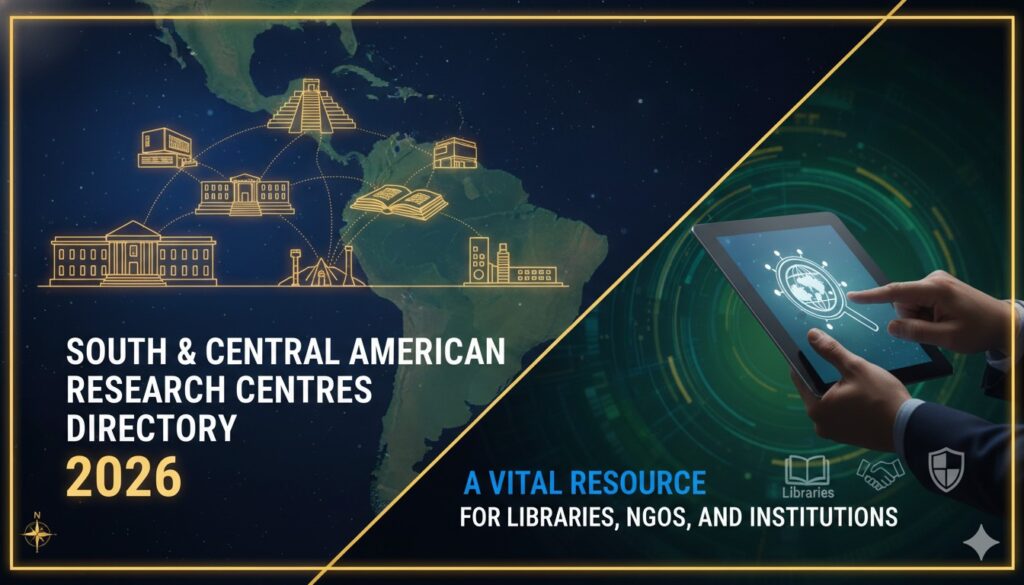

“The 2026 edition of the South & Central American Research Centres Directory stands out as a meticulously organized resource, categorizing hundreds of research centers into 19 subject-specific sections. It provides verified contact details, including emails and URLs, enabling libraries, NGOs, and institutions to efficiently identify partners for collaborative projects, funding pursuits, and knowledge-sharing initiatives in a region rich with diverse expertise.”
South & Central American Research Centres Directory 2026: A Vital Resource for Libraries, NGOs, and Institutions
In an era where cross-border research partnerships drive innovation in fields ranging from biodiversity conservation to public health and sustainable development, access to accurate, up-to-date information on regional research infrastructure has never been more critical. The latest edition of this directory addresses that need head-on by compiling extensive listings of research centers throughout South and Central America.
The directory’s structure enhances usability through its division into 19 distinct subject areas. These categories allow users to navigate specialized domains with precision, grouping entries by country or territory within each section for streamlined reference. This organization reflects the region’s broad research strengths, where institutions tackle pressing local and global challenges.
Key subject areas covered include:
Environmental sciences and ecology, with a focus on Amazonian biodiversity, climate resilience, and conservation efforts.
Biomedical and health sciences, encompassing tropical disease research, epidemiology, and clinical studies.
Social sciences and humanities, addressing migration patterns, economic policy, indigenous rights, and cultural heritage.
Agricultural and earth sciences, including sustainable farming, soil management, and natural resource economics.
Engineering and technology, highlighting renewable energy innovations and infrastructure development.
Other interdisciplinary fields such as marine biology, urban studies, and policy analysis.
This thematic breakdown ensures that users—whether procurement officers at major university libraries, program directors at international NGOs, or grant administrators at funding institutions—can quickly pinpoint relevant entities. For instance, an NGO focused on environmental advocacy can locate centers specializing in rainforest ecosystems, while a library seeking inter-institutional exchanges might target humanities-focused institutes.
The value of the directory extends beyond mere listings. Each entry typically includes comprehensive contact information: institutional names, physical addresses, primary email addresses, official website URLs, and often key personnel or departmental leads. This level of detail supports direct outreach, proposal submissions, and partnership formation without the barriers of outdated or incomplete data.
The region’s research ecosystem continues to evolve dynamically. South America hosts powerhouses in high-impact scientific output, with leading institutions in Brazil and Argentina contributing significantly to global publications in natural sciences. Brazil’s dominance stems from large-scale facilities dedicated to Amazon studies and biotechnology, while Argentina maintains strong networks in agricultural and medical research. Chile excels in astronomy and seismology, leveraging unique geographical advantages, and Colombia advances in biodiversity and pharmacology.
Central America, though smaller in scale, features specialized centers addressing regional priorities such as disaster risk reduction, public health in tropical environments, and sustainable tourism. Countries like Costa Rica emphasize ecotourism research and conservation biology, while institutions in Panama and Guatemala focus on canal-related logistics, archaeology, and community development.
The directory captures this diversity, serving as a bridge for North American and European entities seeking to engage with Latin American counterparts. Libraries benefit by expanding their reference collections and supporting faculty research collaborations. NGOs gain tools to identify local partners for field projects, capacity-building programs, and grant-funded initiatives. Institutions, including think tanks and multilateral organizations, use it to map networks for policy-oriented studies and joint ventures.
In practical terms, the resource empowers strategic decision-making. For example:
A U.S.-based foundation exploring grant opportunities in climate adaptation can target South American centers with proven expertise in carbon sequestration.
An international NGO combating vector-borne diseases can connect with Central American health research units for epidemiological data sharing.
Academic libraries can verify affiliations and contacts to facilitate resource exchanges, such as digital archives or joint publications.
The publication’s emphasis on verified, current data distinguishes it in a crowded field of directories. As research funding increasingly prioritizes collaborative, regionally grounded work—particularly in areas aligned with UN Sustainable Development Goals—the directory positions itself as a foundational tool for fostering equitable partnerships.
Its release aligns with growing interest in Latin American innovation ecosystems, from clinical trial expansions in Brazil, Mexico, and Argentina to tech-driven research hubs in urban centers. By documenting these entities comprehensively, the directory not only preserves institutional knowledge but also catalyzes future advancements.
Disclaimer: This is an informational news report based on publicly available industry developments and does not constitute professional advice, investment recommendations, or endorsements of any specific products or services.