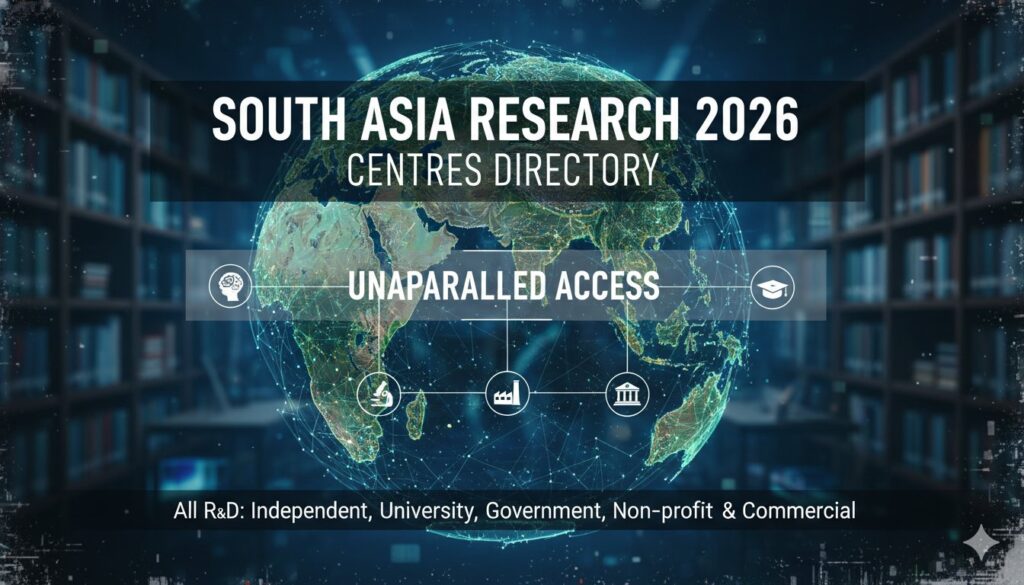

The 2026 edition of the South Asia Research Centres Directory provides unmatched, centralized access to R&D activities in the region, organized across 19 subject categories from agriculture and archaeology to technology and social sciences. It serves as a vital tool for collaboration, funding pursuits, policy formulation, and academic partnerships amid South Asia’s growing innovation landscape.
South Asia Research Centres Directory 2026: A Landmark Resource for Regional Innovation
South Asia continues to emerge as a dynamic hub for research and development, driven by rapid economic growth, increasing investment in science and technology, and pressing regional challenges such as climate change, public health, and sustainable agriculture. The newly available South Asia Research Centres Directory 2026 captures this momentum by offering an exhaustive compilation of entities engaged in R&D across the eight core countries of the region.
This directory stands apart due to its inclusive scope, encompassing not only traditional academic and government institutions but also independent think tanks, non-profits, and private-sector commercial operations. Listings are systematically organized into 19 thematic sections, enabling users to navigate specialized fields efficiently. These categories include Agriculture & Food, Archaeology & Anthropology, Biological & Biomedical Sciences, Business & Economics, Chemistry & Materials Science, Earth & Environmental Sciences, Education, Engineering & Technology, History & Culture, Information Technology & Computer Science, Law & Policy, Mathematics & Physics, Medical & Health Sciences, Social Sciences, Energy & Renewables, Defense & Security, Urban Development, Biotechnology, and Emerging Interdisciplinary Areas.
The publication highlights the diversity of institutional types. In India, which dominates the region’s R&D output due to its scale, major university centers such as those at the Indian Institute of Science and various Indian Institutes of Science Education and Research lead in high-impact publications and innovations. Government-backed entities focus on national priorities like space, atomic energy, and agricultural advancements, while non-profits and think tanks address policy-oriented issues ranging from governance to climate resilience.
Neighboring countries contribute meaningfully despite resource constraints. Bangladesh features strong development-focused institutes emphasizing economics, public health, and disaster management. Pakistan maintains active centers in strategic studies, water resources, and nuclear-related research. Sri Lanka emphasizes environmental and heritage studies, while Nepal and Bhutan prioritize Himalayan ecology, biodiversity, and sustainable development. Afghanistan continues efforts in reconstruction-related research, and the Maldives focuses on marine and climate sciences given its vulnerability to rising seas.
Key trends reflected in the directory include a surge in interdisciplinary work, particularly at the intersection of technology and sustainability. Renewable energy research gains prominence amid global transitions, with centers exploring solar, wind, and hydropower solutions tailored to South Asia’s geography. Biotechnology and health sciences advance through collaborations on vaccine development, tropical diseases, and genomics. Think tanks increasingly influence policy on regional security, trade, and geopolitical dynamics in the Indo-Pacific context.
The directory’s value lies in its facilitation of cross-border partnerships. Researchers, funding agencies, NGOs, and corporations can identify collaborators, access contact details, and explore ongoing projects. For instance, joint initiatives on climate adaptation benefit from shared expertise across borders, while commercial R&D entities seek university partnerships for innovation commercialization.
Challenges persist, including funding disparities, infrastructure gaps in smaller nations, and geopolitical tensions that sometimes hinder collaboration. Yet the directory underscores progress: rising private-sector involvement, international grant inflows, and digital tools enabling virtual exchanges.
A selection of prominent entities and categories illustrates the directory’s depth:
Agriculture & Food : Centers tackling food security, crop resilience, and agrotech innovations, vital in a region with large rural populations.
Earth & Environmental Sciences : Focus on Himalayan glacier monitoring, monsoon patterns, and pollution mitigation.
Engineering & Technology : Emphasis on IT hubs, AI applications, and infrastructure development.
Medical & Health Sciences : Responses to infectious diseases, maternal health, and telemedicine.
Social Sciences & Policy : Think tanks analyzing economic reforms, gender equity, and regional cooperation.
This resource proves indispensable for stakeholders aiming to engage with South Asia’s intellectual ecosystem. Academic libraries, policy organizations, and international agencies will find it a go-to reference for identifying expertise and fostering initiatives that address shared regional priorities.
Disclaimer: This is a news report based on publicly available information about research landscapes and directories. It is for informational purposes only and does not constitute professional advice, investment recommendations, or endorsements.