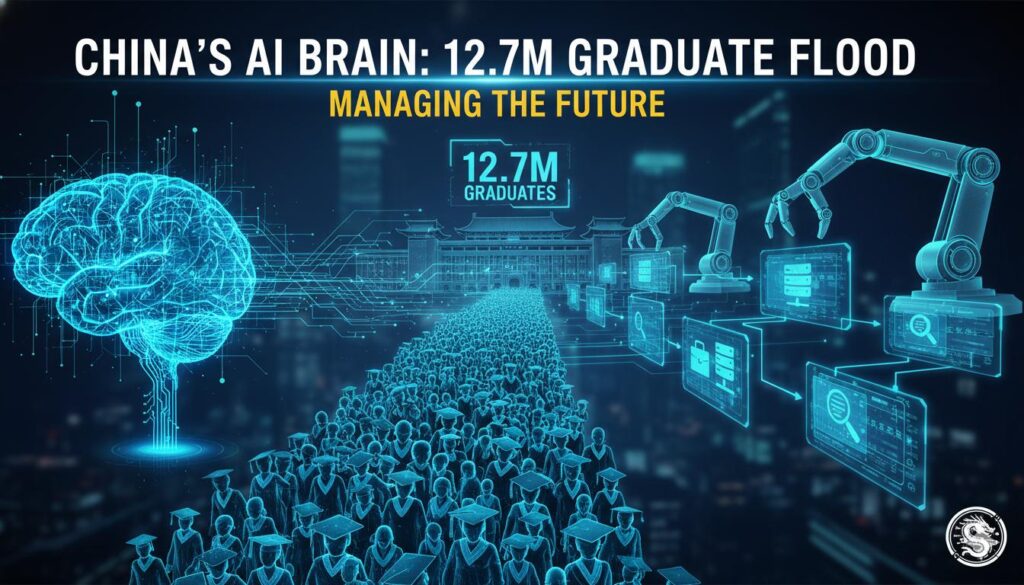

China faces its largest-ever wave of university graduates in 2026, with 12.7 million young professionals set to flood the job market amid persistent economic headwinds and structural mismatches in skills. To counter this, Beijing is pivoting toward AI-driven initiatives: upgrading traditional industries with intelligent technologies, expanding high-tech job creation, launching AI-focused training and internship programs, and using advanced algorithms to match talent with opportunities—aiming to create over 12 million urban jobs while transforming potential unemployment risks into drivers of innovation and productivity.
China Pivots to AI to Manage Record-Breaking 12.7 Million Graduate Influx
The sheer scale of China’s 2026 graduating class—projected at 12.7 million by the Ministry of Education—represents a 480,000 increase over the 12.22 million from the prior year, continuing a multi-decade expansion of higher education access that has lifted gross enrollment rates above 60%. This surge arrives against a backdrop of moderating economic growth, lingering property sector challenges, and global trade uncertainties, all of which have constrained traditional hiring in services, manufacturing, and real estate.
Youth unemployment pressures remain elevated, with urban surveyed rates for younger cohorts hovering in double digits in recent periods. The addition of this massive cohort—equivalent to more than Belgium’s entire population—amplifies competition for quality positions, particularly as many graduates hold degrees in fields where supply outstrips immediate demand.
In response, authorities have positioned AI as a core pillar of the employment strategy. Senior officials, including the Human Resources and Social Security Minister, have emphasized harnessing artificial intelligence to upgrade legacy roles, uncover hidden opportunities across sectors, and facilitate multi-channel talent showcasing. This “AI+” approach aligns with national directives to fuse intelligence with every industry, creating what leaders term “new quality productive forces.”
Key elements of the pivot include large-scale deployment of AI in job matching and career services. National platforms for graduate employment have integrated big-data analytics and algorithmic tools to refine recommendations, host virtual fairs, and aggregate millions of openings. Recent enhancements have enabled more precise pairing of skills with employer needs, reducing mismatches that have plagued prior cohorts.
Internship and vocational training programs are being scaled with an explicit focus on AI competencies. Universities and local governments are rolling out initiatives that embed AI literacy, practical coding, data analysis, and application development into curricula and hands-on experiences. These efforts target both STEM graduates—who form a significant portion of the class—and those from non-technical backgrounds seeking to pivot into emerging roles.
The AI sector itself is exploding as a direct absorber of talent. Output value in the core AI industry surpassed 1.2 trillion yuan in the recent year, with over 6,200 significant enterprises driving demand. Specialized positions in large language models, computer vision, generative AI applications, industrial intelligence, and AI governance command premium compensation, often reaching six-figure annual packages for top performers. Projections indicate a persistent talent shortfall, with estimates suggesting millions more specialists needed in the coming years to meet ambitious targets.
Sector-Specific Impacts and Job Creation Dynamics
AI integration is reshaping hiring across industries:
Manufacturing and Industrial Upgrades — Under initiatives tied to high-tech self-reliance, factories are adopting intelligent automation, robotics, and predictive maintenance systems. This creates demand for AI engineers to oversee implementation, while preserving and transforming roles for human oversight and creative problem-solving.
Digital Economy and Services — E-commerce, fintech, and content platforms leverage AI for personalization, fraud detection, and customer interaction. New occupations such as generative AI operators and prompt engineers have emerged, drawing in graduates skilled in natural language processing and machine learning.
Healthcare and Biotech — AI-driven drug discovery and diagnostics tools are accelerating, requiring interdisciplinary talent blending biology with computational expertise.
Education and Public Services — Adaptive learning platforms and administrative AI assistants are expanding, opening avenues for graduates to apply tech in non-traditional settings.
Graduate Employment Statistics Overview (Recent Trends)
| Category | 2025 Graduates | 2026 Projection | Change | Notes |
|---|---|---|---|---|
| Total College Graduates | 12.22 million | 12.7 million | +480,000 | Record high; Ministry of Education data |
| Urban Job Target | N/A | >12 million | N/A | Government goal for 2026 |
| AI-Related Job Postings Growth | Varied (3-39% applicant surge in recent quarters) | Accelerating | High demand in tech hubs | Zhaopin and similar platforms |
| Youth Unemployment (Urban Surveyed, Recent) | ~14-17% range | Persistent pressure | Stable but elevated | Excluding students; cohort-specific higher |
To bolster absorption, regional collaborations are intensifying. Provinces and cities are mobilizing resources for targeted campaigns, including “Golden Autumn” recruitment drives that have already generated millions of postings. Disadvantaged groups receive prioritized support, while entrepreneurship incentives encourage graduates to launch AI-enabled ventures.
The strategy also addresses potential downsides: while AI augments productivity, it risks displacing routine tasks. Beijing counters this by emphasizing reskilling, promoting hybrid human-AI workflows, and directing investment toward roles requiring judgment, creativity, and ethical oversight—areas where young talent can excel.
This multifaceted push reflects a calculated bet: that rapid AI adoption can convert demographic pressure into a competitive advantage, fueling innovation-led growth and positioning China as a global leader in intelligent technologies.
Disclaimer: This is general news and analysis based on publicly available information; it does not constitute financial, career, or investment advice.