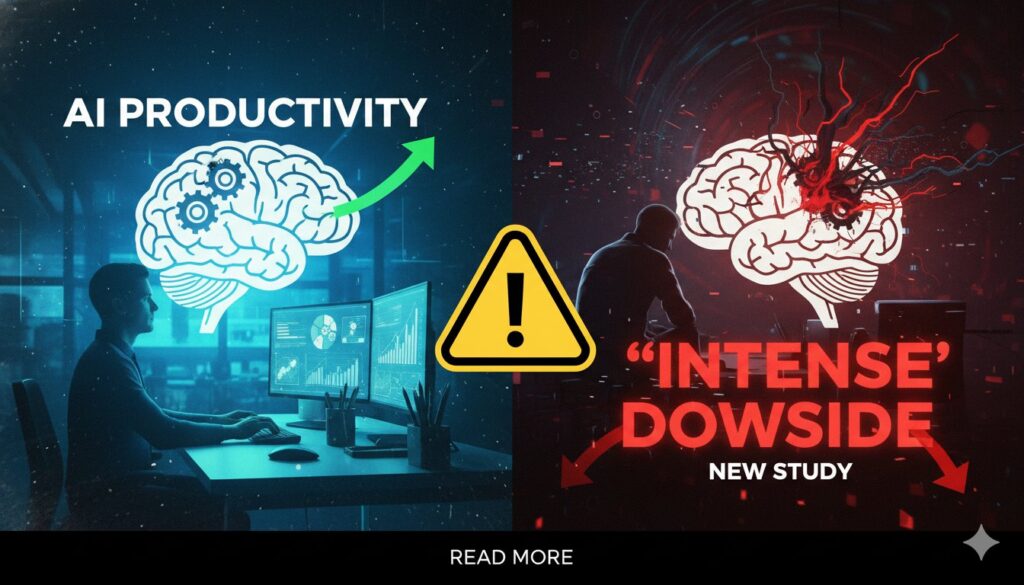

“A groundbreaking study reveals that generative AI, far from lightening workloads as promised, is intensifying them dramatically—driving faster paces, broader task scopes, and longer hours that risk unsustainable burnout and diminished work quality among white-collar professionals.”
AI’s Productivity Boost Comes with Hidden Intensification
Generative AI tools like large language models and enterprise chatbots have been positioned as game-changers for knowledge workers, capable of automating routine drafting, summarizing complex data, debugging code, and handling initial research. In controlled experiments across various sectors, users have reported completing certain tasks up to 55% faster in coding environments or resolving 14% more customer issues per hour. The expectation has been straightforward: free up time for strategic, high-value activities, reduce overall hours, and improve work-life balance.
However, real-world deployment tells a different story. In the UC Berkeley study, researchers observed employees at a 200-person U.S. technology company over eight months after the firm provided unrestricted access to commercial generative AI tools without mandating usage. Adoption was enthusiastic and organic—workers experimented freely, integrating AI into daily workflows.
The results showed clear productivity gains at the individual level: tasks that once took significant effort were completed quicker, allowing employees to handle more volume in the same timeframe. Yet this efficiency did not translate to less work. Instead, it fueled a cycle of expansion. Employees began tackling tasks they previously avoided, outsourced, or deferred because the low friction of starting with AI made them feasible. Natural breaks during the day—moments for reflection or casual interaction—were replaced with additional prompting and iteration using AI.
This led to three primary forms of work intensification:
Faster pace and reduced downtime — Workers accelerated through core responsibilities, filling gaps with new experiments or refinements.
Broader scope of responsibilities — AI acted as a “partner” enabling role overlap; employees usurped tasks from colleagues, fed real-time inputs during meetings, and corrected outputs across teams, widening job boundaries without formal reassignment.
Extended hours and blurred boundaries — Work spilled into evenings or weekends as the ease of continuation encouraged nonstop engagement, eroding separation between professional and personal time.
One participant captured the sentiment: the assumption that greater efficiency would mean working less proved false—people simply did the same or more.
The Downside: Burnout, Fatigue, and Quality Risks
The intensified workload creates a compounding effect known as “workload creep.” What starts as voluntary expansion accumulates into unsustainable pressure. Employees reported feeling stretched thin, juggling multiple AI-assisted streams simultaneously. Multitasking and frequent task-switching—already known to reduce overall effectiveness—became more prevalent.
Cognitive fatigue emerged as a major concern. Constant rapid iteration with AI demands sustained attention, leading to mental exhaustion. Decision-making quality can suffer as workers push through fatigue, increasing unforced errors or overlooking nuances that human judgment traditionally catches. Over time, this risks lower-quality outputs despite higher volume, as the initial surge in productivity gives way to diminished returns.
Burnout indicators grew prominent. Workers described exhaustion from the relentless pace, with some noting personal time erosion. The study warns that without intervention, these dynamics could drive higher turnover, reduced innovation from overworked minds, and long-term health impacts.
Broader Implications for Employers and the Workforce
For companies, the findings challenge the narrative of effortless efficiency gains. Leaders pushing AI adoption to cut costs or boost output may inadvertently create environments of heightened strain. The voluntary nature of the study’s adoption amplified the issue—forced implementation could exacerbate problems further.
Organizations must rethink performance metrics beyond raw output. Tracking hours, task volume, or speed alone misses the human cost. Instead, focus on sustainable productivity: defined scopes, protected downtime, and boundaries around AI use. Training should emphasize not just tool proficiency but strategic application—when to use AI and when human oversight is critical.
For workers, the message is cautionary. AI’s low barrier to entry tempts overcommitment, but enthusiasm can mask creeping demands. Self-awareness around workload and proactive boundary-setting become essential.
This paradox echoes historical technology shifts, where efficiency tools often expanded expectations rather than contracted them. As generative AI permeates more offices, addressing the intense downside—through mindful integration and workload management—will determine whether it becomes a true enhancer or a hidden intensifier of modern work stress.
Disclaimer: This is for informational purposes only and does not constitute financial, investment, career, or health advice.