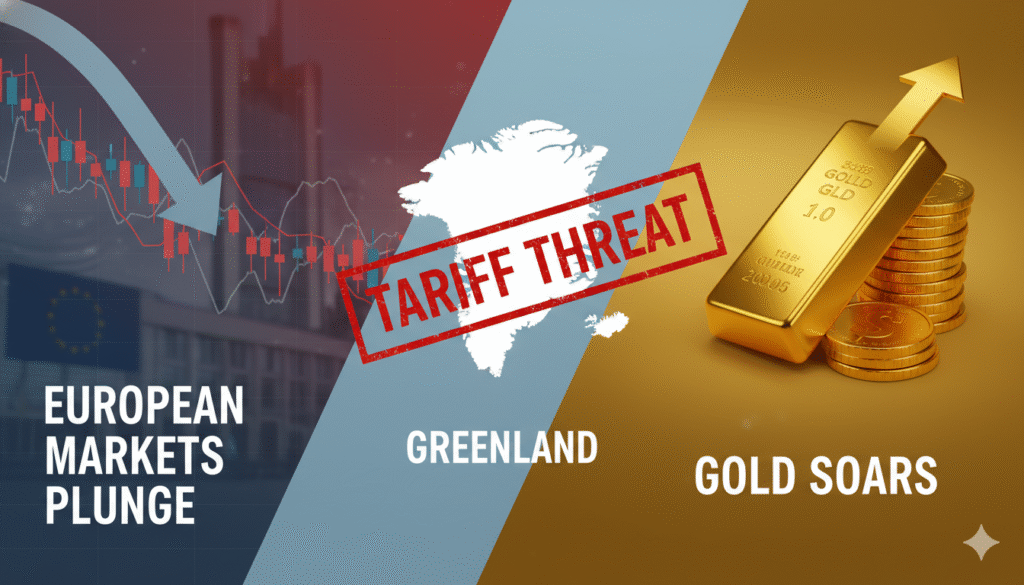

“European stock indices experienced modest declines amid uncertainty from U.S. tariff threats tied to Greenland territorial disputes, while gold prices surged as investors sought safe havens, with forecasts pointing to further gains driven by geopolitical tensions and strong demand.”
European equity markets faced downward pressure this week, marking an end to a prolonged winning streak as geopolitical frictions escalated. The pan-European STOXX 600 index slipped 0.1% to close at 608.34 points, snapping a five-week rally that had been its longest since mid-last year. This retreat came amid broader concerns over potential U.S. tariffs on several European nations, stemming from disputes over strategic control in the Arctic region. Investors reacted cautiously, with selling intensifying in sectors sensitive to trade disruptions, such as manufacturing and exports.
Key European benchmarks reflected the unease. The FTSE 100 in London edged down 0.07% to 10,143.44, influenced by weakness in mining and energy stocks. Germany’s DAX rose marginally by 0.18% to 24,900.71, bucking the trend slightly due to resilient tech and automotive shares, but still contributing to the overall weekly loss. France’s CAC 40 dipped 0.07% to 8,143.05, while the EURO STOXX 50 fell 0.13% to 5,948.20. Belgium’s BEL 20 saw a steeper decline of 0.26% to 5,316.43. Across the board, the STOXX 600 has shed about 1% so far this week, positioning it for its first weekly drop in over a month.
The tariff threats, centered on U.S. demands for enhanced influence over Greenland—cited as a national security priority against expanding Chinese and Russian interests—rattled investor sentiment. Although the U.S. administration later indicated a “framework” for future discussions, the initial saber-rattling prompted a flight to quality assets. European leaders responded with unity, pausing trade deal negotiations and exploring alternative partnerships, which further amplified market volatility. Analysts note that such threats could exacerbate existing pressures from slowing global growth and persistent inflation, potentially leading to broader supply chain disruptions for U.S.-exposed firms.
In a detailed breakdown of sector performance, luxury goods and automotive exporters bore the brunt of the sell-off, with declines averaging 1.5-2% due to fears of retaliatory measures. Conversely, defensive sectors like utilities and healthcare held steady, providing some cushion. The broader Euro Area stock market index (EU50) closed at 5,953 points, down 0.03% on the session, underscoring the tentative mood.
| European Index | Closing Value | Daily Change | Percentage Change | Weekly Performance |
|---|---|---|---|---|
| STOXX 600 | 608.34 | -0.61 | -0.10% | -1.00% |
| FTSE 100 | 10,143.44 | -6.61 | -0.07% | -0.39% |
| DAX | 24,900.71 | +44.24 | +0.18% | -1.33% |
| CAC 40 | 8,143.05 | -5.84 | -0.07% | -1.78% |
| EURO STOXX 50 | 5,948.20 | -7.97 | -0.13% | -0.50% |
| BEL 20 | 5,316.43 | -14.08 | -0.26% | -0.75% |
Gold, often viewed as a barometer for economic and geopolitical stress, emerged as a bright spot amid the turmoil. Prices for February gold futures climbed to 4,979.70 USD per troy ounce, up 66.30 USD or 1.35% on the day. This surge builds on a robust monthly gain of 12.04%, with the metal up 11.35% over the past 30 days and an impressive 79.93% over the last year. The rally is fueled by a combination of safe-haven buying, central bank purchases, and expectations of sustained low interest rates, which reduce the opportunity cost of holding non-yielding assets.
Investment banks have revised their outlooks upward in response. Forecasts now project gold reaching 5,400 USD per ounce by year-end, a 10% increase from prior estimates, driven by private-sector demand and ongoing global uncertainties. Over the longer term, prices could approach 5,000-6,000 USD, supported by factors like de-dollarization trends and heightened purchases from emerging market central banks. Silver, often moving in tandem, has outperformed with even sharper gains, highlighting the broader appeal of precious metals.
The Greenland dispute has broader implications for commodity markets, as the territory holds significant rare earth minerals critical for technology and defense industries. U.S. assertions of strategic necessity—aimed at countering foreign encroachments—have sparked debates on alliance dynamics, with European nations pushing back against perceived strong-arm tactics. This has led to increased hedging activity among U.S. investors, who see gold as a hedge against potential trade war escalations that could impact domestic portfolios exposed to international trade.
Breaking down gold’s performance trends:
Short-term Momentum : Up 7.87% over five days, reflecting immediate risk-off sentiment.
Medium-term Strength : 46.72% gain over six months, bolstered by central bank buying.
Long-term Trajectory : 168.35% over five years, underscoring its role as an inflation hedge.
All-time Perspective : An extraordinary 1,718.07% rise, cementing gold’s status as a core portfolio diversifier.
Market participants are closely monitoring any further developments in U.S.-Europe relations, as resolved tensions could spur a rebound in equities, while prolonged uncertainty might sustain gold’s upward path. Volatility indices in Europe have ticked higher, signaling potential for continued choppiness. For U.S. audiences, this scenario underscores the interconnectedness of global markets, where Arctic geopolitics can ripple through to Wall Street via trade-sensitive sectors.
In terms of broader economic context, the tariff overhang coincides with forecasts of modest European stock returns for the year, pegged at around 3-4% earnings growth amid resilient but slowing expansion. Valuations have approached fair value after a strong start to the year, leaving limited buffers against shocks. Gold’s appeal, meanwhile, is amplified by projections of ongoing geopolitical risks, including Arctic rivalries and supply chain vulnerabilities.
Key Points on Market Dynamics:
Tariff threats prompted a unified European response, accelerating discussions on alternative trade alignments.
Gold’s rise is multifaceted, combining safe-haven flows with structural demand from investors and institutions.
European stocks’ weekly loss highlights fragility in export-heavy economies, with potential spillover to U.S. multinationals.
Analysts anticipate gold prices to test new highs if tensions persist, offering opportunities for diversified portfolios.
The interplay between these elements illustrates how swiftly geopolitical events can influence financial landscapes, prompting shifts in asset allocation strategies.
Disclaimer: This news report provides informational tips based on available sources and does not constitute financial advice or recommendations.